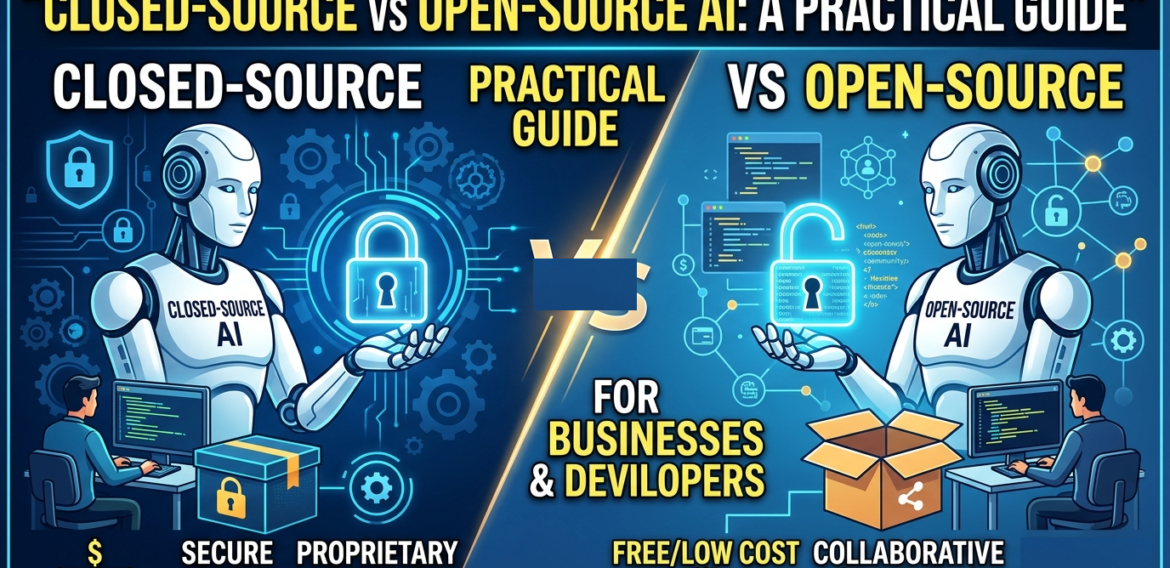
Closed-Source vs Open-Source AI Models: A Practical Guide for Businesses and Developers
Artificial Intelligence is no longer just a research topic—it’s a core business capability. But one of the most important decisions organizations face today is whether to use closed-source or open-source AI models. Each approach comes with its own strengths, trade-offs, and ideal use cases.
Let’s break this down in a clear, practical way.
🔒 What Are Closed-Source AI Models?
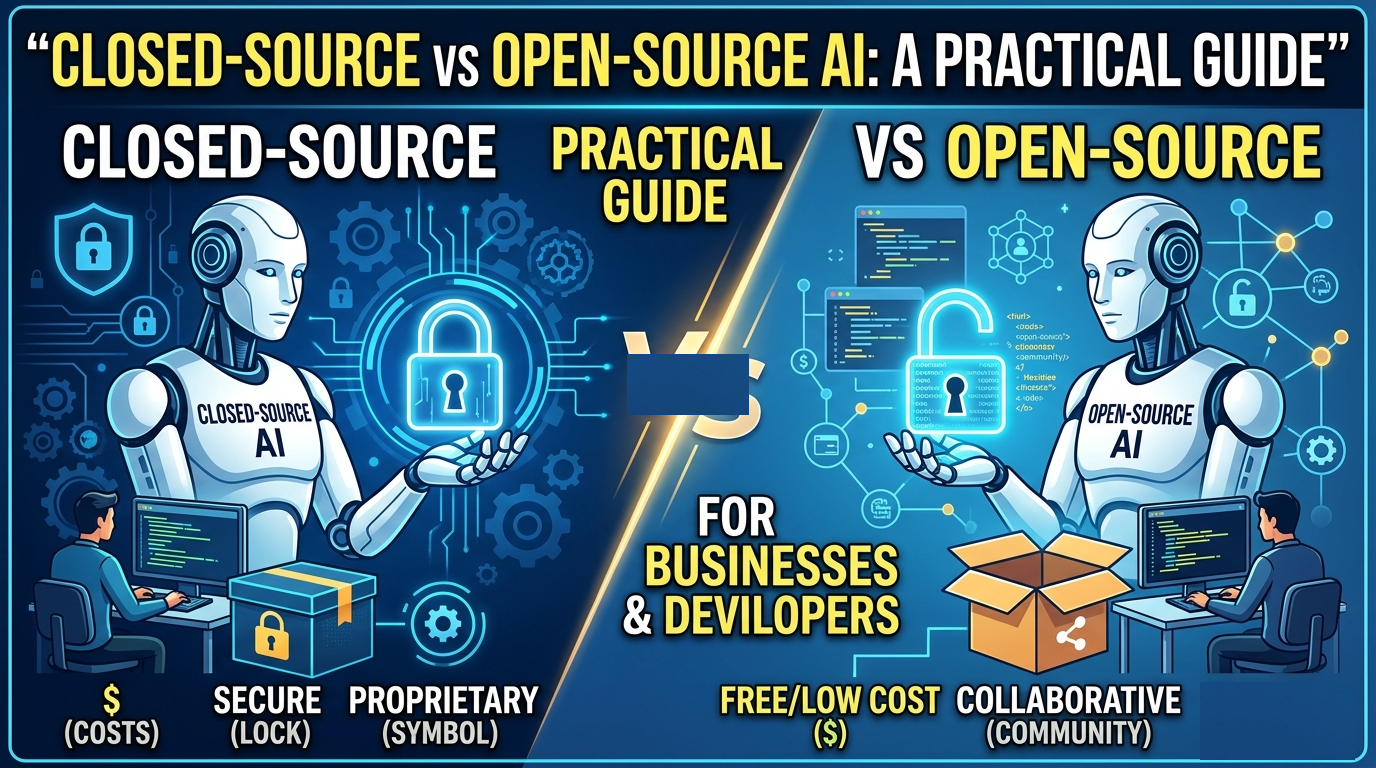
Closed-source models are proprietary systems where the underlying code, training data, and model weights are not publicly available. You access them via APIs or platforms, but you don’t get full control over how they work.
Popular Examples
- GPT-4 / ChatGPT by OpenAI
- Claude by Anthropic
- Gemini by Google
- Copilot by Microsoft
Key Characteristics
- Hosted and managed by vendors
- Access via API or SaaS platforms
- Limited customization at core level
- Strong focus on performance and safety
Advantages
- State-of-the-art performance (often leading benchmarks)
- Ease of use—no infrastructure setup required
- Enterprise-grade support and reliability
- Continuous updates without effort
Limitations
- Vendor lock-in
- Usage costs can scale quickly
- Limited transparency into training data and biases
- Restricted control over model behavior
🌐 What Are Open-Source AI Models?
Open-source models make their architecture, weights, and sometimes training data publicly available. Developers can download, modify, and deploy them independently.
Popular Examples
- LLaMA by Meta
- Mistral by Mistral AI
- Stable Diffusion by Stability AI
Key Characteristics
- Fully or partially accessible model internals
- Can be self-hosted (on-prem or cloud)
- Highly customizable
- Community-driven innovation
Advantages
- Full control and flexibility
- No vendor dependency
- Ability to fine-tune for domain-specific use cases
- Potentially lower long-term cost
Limitations
- Requires technical expertise to deploy and maintain
- Infrastructure costs (GPU, scaling, security)
- May lag behind closed models in cutting-edge performance
- Less built-in safety and guardrails
⚖️ Head-to-Head Comparison
| Feature | Closed-Source Models | Open-Source Models |
|---|---|---|
| Transparency | Low | High |
| Customization | Limited | Extensive |
| Setup Effort | Minimal | High |
| Cost Structure | Pay-per-use | Infra + maintenance |
| Performance | Often leading | Improving rapidly |
| Control | Vendor-controlled | User-controlled |
🧩 When Should You Choose What?
Choose Closed-Source If:
- You want quick implementation
- You don’t have a strong AI/ML engineering team
- You need reliable, production-ready AI
- Use case: chatbots, content generation, enterprise copilots
Choose Open-Source If:
- You need data privacy and control
- You want to fine-tune models for niche domains
- You aim to build custom AI products
- Use case: healthcare AI, financial models, proprietary systems
🧠 Final Thoughts
There’s no one-size-fits-all answer. The choice between closed and open source depends on your:
- Business goals
- Technical capability
- Budget
- Data sensitivity
Closed-source models offer power and simplicity, while open-source models provide freedom and control.
The smartest move is not picking one side—but knowing when to use each.