Types of Prompting: Techniques to Get Better Results from AI
Writing a clear prompt is the first step toward getting useful responses from AI. However, not every task requires the same way of giving instructions. Sometimes a simple question is enough, while other tasks require examples, multiple steps, or a specific output format.
This is where different prompting techniques come into play. They help us guide AI based on what we want to achieve, making our interactions more useful and the responses more relevant to the task.
Let’s explore some commonly used prompting techniques.
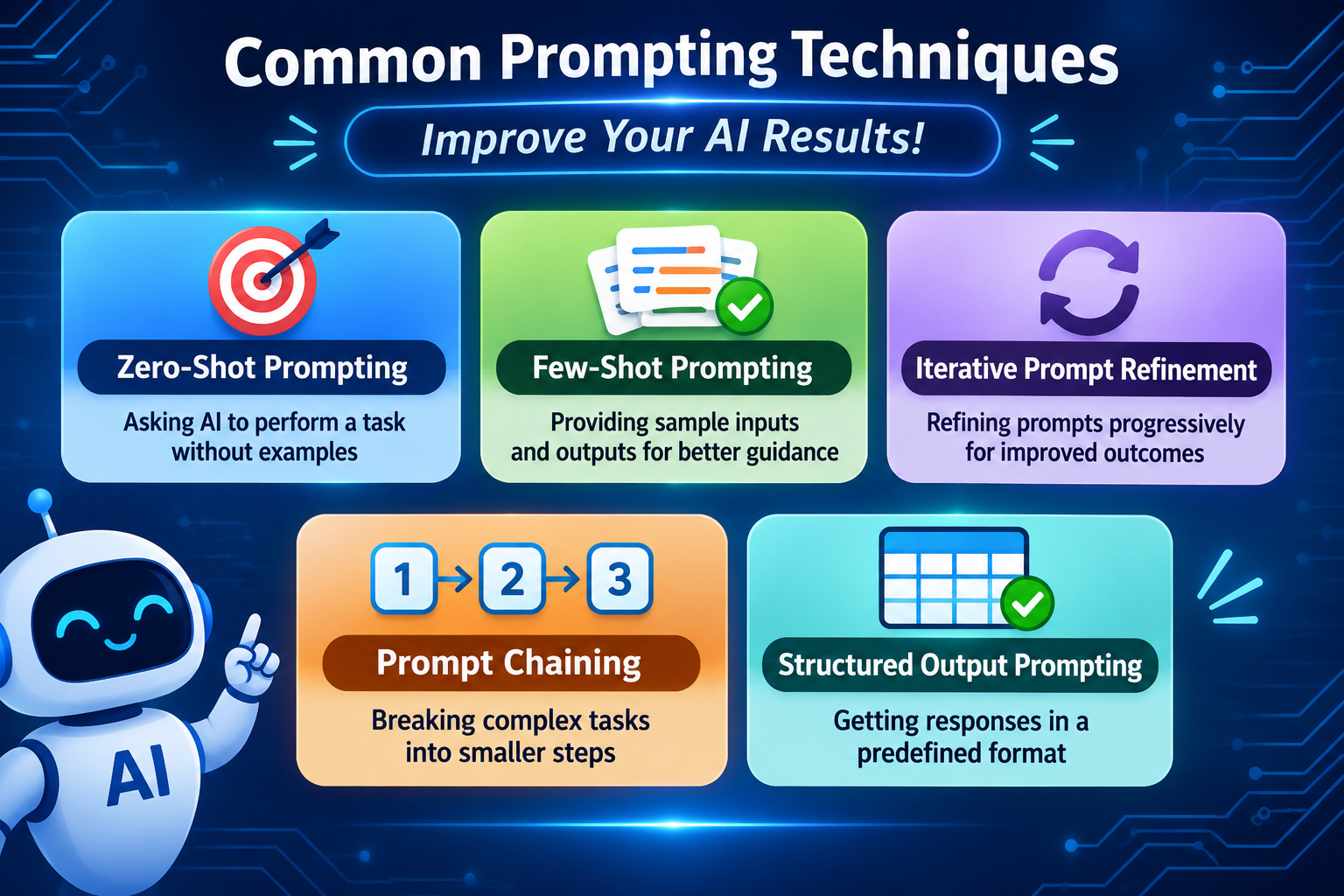
1. Zero-Shot Prompting
Zero-shot prompting means asking an AI to perform a task without providing any examples. The AI relies on the instructions and its existing knowledge to generate a response.
Example Prompt:
Categorize the following customer feedback as Positive, Negative, or Neutral:
“The product arrived on time, but the packaging was damaged.”
When to use it: When the task is straightforward and the instructions are clear, such as summarizing text, answering questions, translating content, or basic classification.
2. Few-Shot Prompting
Few-shot prompting involves providing a few examples before asking the AI to perform the actual task. These examples help the AI understand the pattern, style, or format you expect.
Example Prompt:
Categorize customer feedback as Positive, Negative, or Neutral.
Feedback: “Excellent service and quick delivery.”
Category: Positive
Feedback: “The product was broken when I received it.”
Category: Negative
Feedback: “The item is okay, but nothing special.”
Category: Neutral
Now categorize this feedback: “The delivery was late, but the support team was helpful.”
When to use it: When you need consistent responses, follow a specific pattern, or want the AI to understand your preferred style of classification or formatting.
3. Iterative Prompt Refinement
The first response generated by AI may not always meet our expectations. Iterative prompt refinement is the process of improving the result by providing specific feedback and adjusting the prompt until the response better matches our requirements.
Instead of starting over, we can guide the AI to make targeted changes.
Example:
Initial instruction:
“Write a summary of this project report.”
After reviewing the response, we can refine it:
“Shorten the summary to 150 words, highlight the key findings first, and remove unnecessary background information.”
We can continue making adjustments, such as asking the AI to simplify the language or include specific details.
When to use it: When the initial response needs improvement in length, tone, clarity, accuracy, or structure.
4. Prompt Chaining
Prompt chaining involves dividing a complex task into smaller steps, where the output of one step becomes the input for the next. Instead of asking AI to complete everything in a single prompt, we handle each stage separately and review the results along the way.
Example: Preparing meeting follow-ups
A meeting transcript can be processed through a sequence of prompts:
- Step 1: Extract the important decisions from the meeting.
- Step 2: Identify the action items based on those decisions.
- Step 3: Create an action table with task, owner, and deadline.
- Step 4: Draft a follow-up email using the confirmed action items.
Each step builds on the previous one, making the overall task easier to review and manage.
When to use it: For complex tasks involving multiple stages, such as analyzing documents, preparing reports, processing meeting notes, or creating content from research.
5. Structured Output Prompting
Structured output prompting involves instructing AI to return information in a predefined format, such as a table, CSV, JSON, or specific columns. This is useful when the generated information needs to be organized, compared, or transferred into another tool.
Example Prompt:
Categorize the following customer support tickets into a table with these columns: Ticket ID, Category, Urgency, and Assigned Department. Use only High, Medium, or Low for urgency. If any information is missing, write “Not stated” instead of guessing.
This helps produce consistent, organized information that is easier to review and work with.
When to use it: When handling data, categorizing records, preparing reports, creating tables, or transferring AI-generated information into Excel or other applications.
Choosing the Right Prompting Technique
Different techniques serve different purposes. A simple task may need only zero-shot prompting, while tasks requiring consistent patterns may benefit from few-shot prompting. Complex workflows can be divided using prompt chaining, and responses can be improved through iterative refinement or structured outputs.
The key is to choose the technique according to the task rather than making every prompt unnecessarily complicated.
Conclusion
Prompting is not limited to asking questions. It involves choosing the right way to communicate with AI depending on the result we want.
Zero-shot and few-shot prompting help guide AI through instructions and examples, iterative refinement helps improve responses, prompt chaining simplifies complex tasks, and structured outputs make information easier to use.
By understanding these techniques, we can move beyond basic AI conversations and use AI more effectively for practical tasks.
If you want to understand how to write clearer and more effective prompts before exploring these techniques, read our previous article: Prompt Engineering with the RGCCO Framework