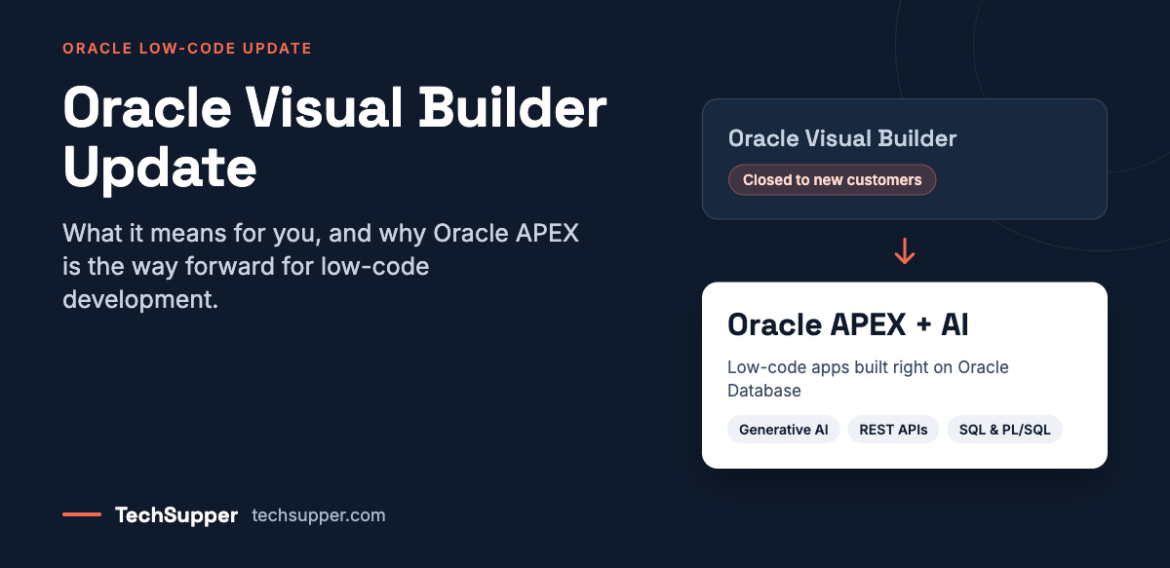
Oracle Visual Builder Availability Change Explained (and Why Oracle APEX Is the Right Fit)
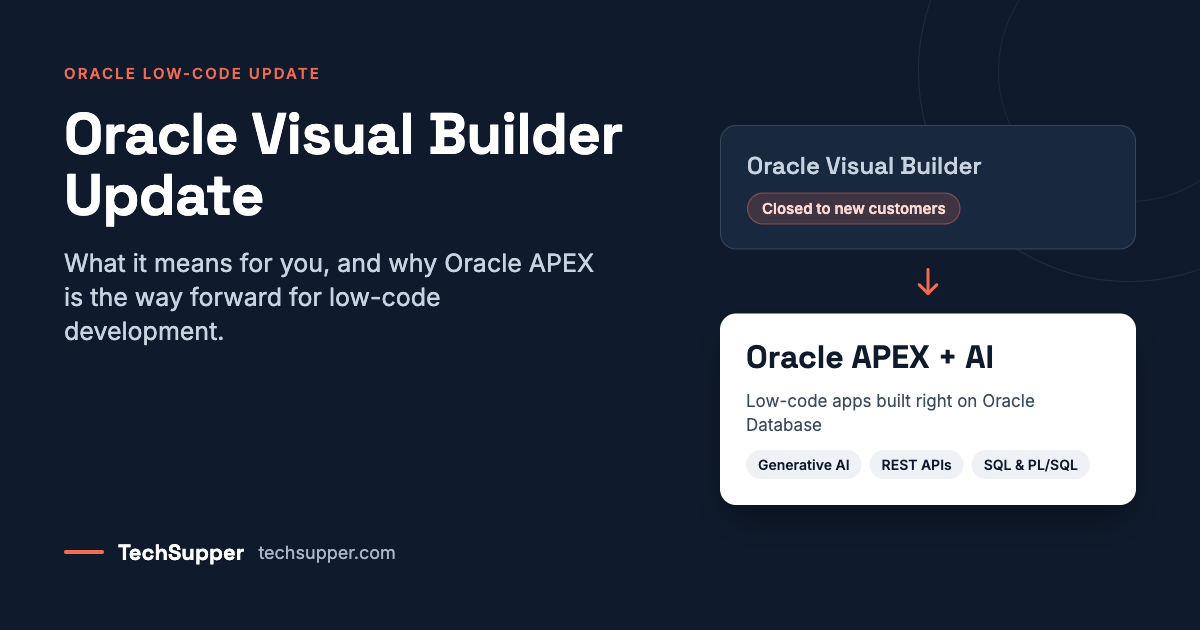
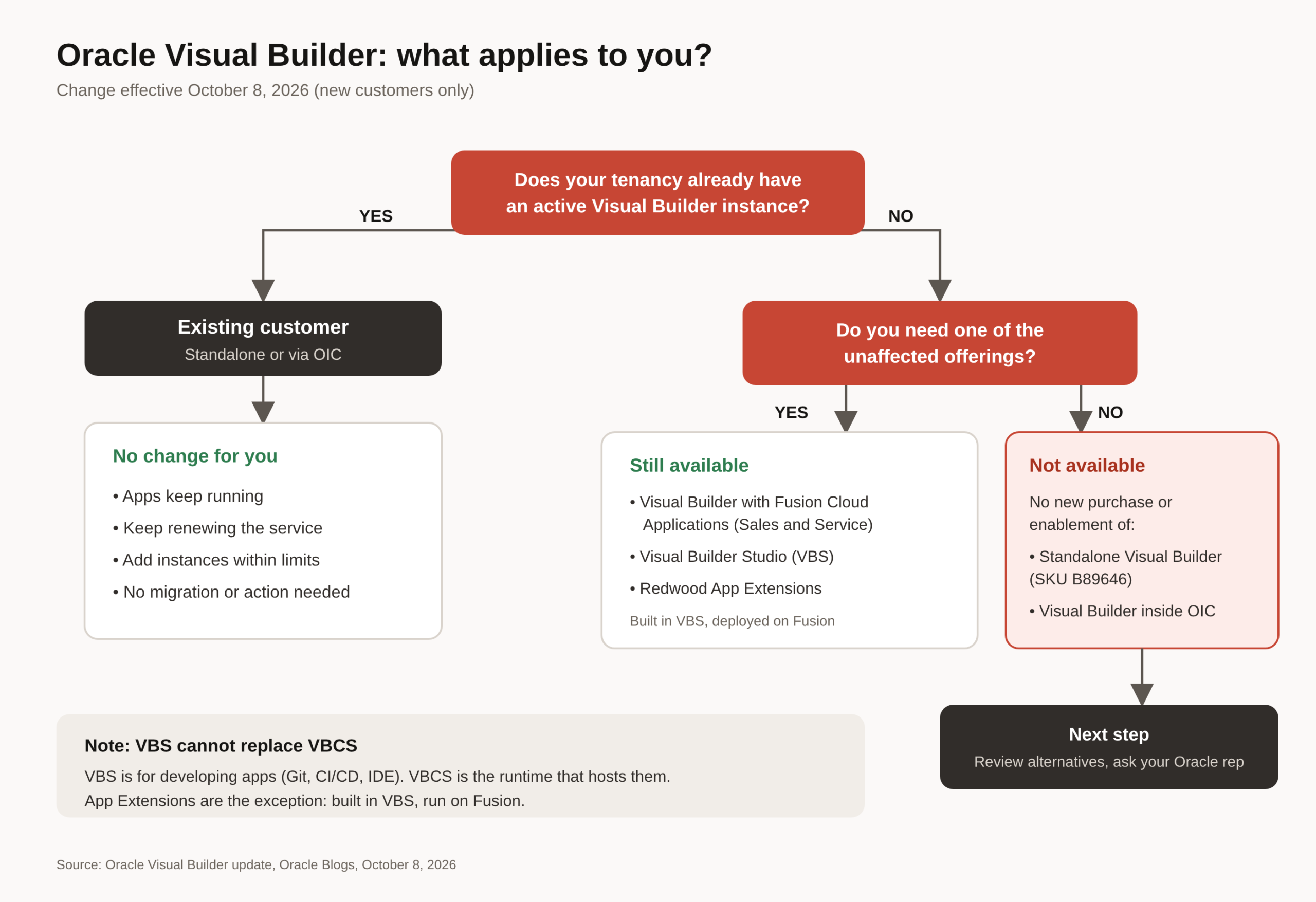
Oracle has changed how new customers can get Visual Builder (VBCS). Starting October 8, 2026, two of its offerings can no longer be bought or enabled by anyone who has never used the service before:
- Standalone Oracle Visual Builder (SKU B89646), provisioned from the OCI console
- Visual Builder inside Oracle Integration Cloud (OIC), enabled from within an OIC instance
Existing customers are not affected. Oracle has said it will keep running, maintaining, and supporting current environments.
Does this affect you?
If you already have an active Visual Builder instance (standalone or through OIC), nothing changes for you:
- Your apps keep running.
- You can keep renewing the service.
- You can still add more instances in the same tenancy, within the normal service limits.
- You do not need to migrate or take any action.
If your tenancy has no active Visual Builder instance, you can no longer create or enable one. This is the group the change targets.
What is not affected
Three related offerings continue as before:
- Visual Builder bundled with Fusion Cloud Applications (Sales and Service), typically used for Digital Customer Service portals
- Visual Builder Studio (VBS), which is a separate product
- Redwood App Extensions (App UIs), which are built in VBS and deployed on Fusion Applications
What happens to existing apps?
Oracle has not announced an end-of-life date, and it is not asking anyone to rewrite or move applications. Support, security fixes, and patches continue for the affected offerings.
Can VBS replace VBCS?
Not directly, because the two do different jobs:
| Visual Builder (VBCS) | Visual Builder Studio (VBS) | |
|---|---|---|
| Purpose | Hosting and running apps | Developing and managing apps |
| Offers | Runtime platform | Git, CI/CD, IDE, build pipelines |
| Can host apps? | Yes | No |
VBS can store and develop your apps, but you still need a VBCS runtime to host them. The exception is App Extensions, which are built in VBS and run on Fusion, so they are unaffected.
Alternative to Visual Builder:
Oracle has not officially announced a replacement for Visual Builder. The update doesn’t retire the product. It stops new customers from buying or enabling it, while existing customers can keep running, renewing, and expanding their instances with no migration needed.
That still leaves a practical question for anyone starting a new project or planning their next skill: if Visual Builder isn’t an option, what should you build with?
From TechSupper’s point of view, Oracle APEX (Application Express) is the right fit for low-code development in the Oracle ecosystem. Here’s why:
- Mature and actively developed: APEX has been part of Oracle Database for over two decades and gets regular releases and a large, active community.
- Built into the database: APEX runs inside Oracle Database, including Autonomous Database, at no extra licence cost. Your data, business logic and UI all live in one place.
- Fast to build: You can build forms, reports, dashboards, approvals and REST integrations declaratively. When you need full control, you can drop into SQL, PL/SQL or JavaScript.
- Ready for AI: Recent releases bring generative AI into both the builder and the apps you build. Features like AI assistants and chatting with your data can connect to OCI Generative AI and other providers.
- Easy to start: You can get a free workspace on apex.oracle.com or use an Always Free Autonomous Database and start building the same day.
For developers coming from Visual Builder, much of the thinking carries over: designing pages, binding them to data, calling REST services, and building secure, responsive business apps. The main change is that APEX is built around the database, so SQL and PL/SQL skills matter even more. For many Oracle professionals, that’s a strength they already have.
TechSupper offers a comprehensive Oracle APEX training that teaches APEX together with AI.
If you’re moving on from Visual Builder or starting low-code development fresh, this training will get you job-ready on APEX with AI.
Explore the APEX Master class HERE
Practical takeaways
- Keep your instance active. For a tenancy that already has one, renewing it preserves your ability to use and expand Visual Builder. Letting the last instance lapse could put you in the “no active instance” group.
- Plan new projects carefully. If you are a new customer or a new tenancy, you cannot rely on Visual Builder for future UI work. Check Oracle’s alternatives, such as Redwood App Extensions for Fusion-related UIs, or other front-end tooling.
- Consultants and partners should check client tenancies. Before proposing a VBCS-based solution, confirm the client already has an active instance.
- Read the official notice and talk to your Oracle account representative for your specific licensing situation.